Vitamins & Nutrients for Healthy Hair
What each nutrient does, and where the evidence stops.
Last reviewed by the Hairavie editorial team on September 1, 2026.
On this page
How to read this guide
For each nutrient there are four separate questions: what it does biologically, whether deficiency can affect hair, whether extra helps someone who isn't deficient, and when professional evaluation makes sense.
Those questions have different answers, and collapsing them is how supplement marketing works.
Hairavie does not tell you that you are deficient, and never recommends that everyone supplement. Deficiency is identified by a qualified healthcare professional, usually with testing.
Protein
Hair fibre is largely keratin, a protein. Severe protein restriction has been associated with hair changes, including increased shedding.
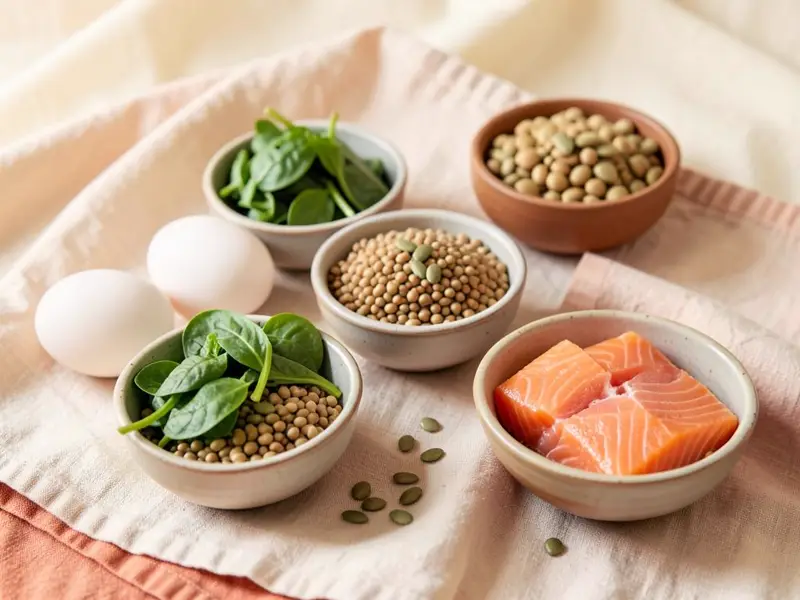
For people already eating adequate protein, eating more has not been established to speed hair growth. Sources include eggs, fish, poultry, Greek yogurt, tofu, beans and lentils.
Iron
Iron supports oxygen transport and many cellular processes. Low iron stores have been associated with hair shedding in some studies, though the relationship is debated and not consistent across all research.
Iron supplementation is not something to start on your own. Excess iron can be harmful, and low iron has causes that deserve investigation. Testing and dosing belong with a healthcare professional.
Food sources include lean meats, beans, lentils, fortified cereals and leafy greens. Vitamin C-rich foods eaten alongside plant sources can support absorption.
Zinc
Zinc participates in protein synthesis and cell division. Clear deficiency can affect hair and skin, but it is uncommon in people eating a varied diet.
High-dose zinc over time can interfere with copper status, which is one reason casual long-term supplementation isn't a neutral choice. Sources include meat, shellfish where appropriate, beans, nuts and seeds.
Vitamin D
Vitamin D receptors are involved in hair follicle cycling, and low vitamin D has been observed in association with several hair-loss conditions. Association is not the same as cause, and supplementation trials for hair outcomes remain limited.
Sources include fatty fish, egg yolks and fortified foods. Status is best assessed by a professional rather than guessed at.
Biotin
Biotin is genuinely necessary for normal hair and nail biology, and true deficiency can cause hair changes. Deficiency is uncommon in people eating a varied diet.
Evidence does not establish that high-dose biotin makes hair grow faster in people who are not deficient. Most positive reports involve people with an underlying deficiency or a specific condition.
Safety note: high-dose biotin can interfere with certain laboratory tests, including some thyroid and cardiac assays. The FDA has issued a safety communication about this. Tell your clinician if you take it.
Vitamin B12 and folate
Both support red blood cell formation and cell division. Deficiency — more likely with certain diets, absorption conditions or medications — can be associated with hair changes as part of a wider picture.
As with iron, this is a testing-and-clinician question rather than a shelf-of-supplements question.
More is not better
Nutrients work within ranges. Below the range, function suffers. Inside it, adding more generally does nothing extra. Above it, several nutrients cause harm — and some hair-loss cases have been linked to excessive intake of specific supplements.
"It's just a vitamin" is not a safety argument.
When professional evaluation is appropriate
- Sudden, heavy or persistent shedding
- Visible thinning, widening parts or bald areas
- Scalp pain, sores, scaling or persistent itch
- Hair changes alongside fatigue, weight changes or other symptoms
- Restrictive eating patterns or known absorption conditions
How Hairavie knows this
Hairavie cites peer-reviewed research, scientific reviews, reference textbooks, dermatology organisations and government health resources. Beauty blogs are never used as scientific authority.
- Scientific reviewAlmohanna, H. M. et al. (2019). The role of vitamins and minerals in hair loss: a review. Dermatology and Therapy (Heidelberg)
- Government health resourceBiotin — Health Professional Fact Sheet. NIH Office of Dietary Supplements. View source
- Regulatory guidanceBiotin may interfere with lab tests: FDA safety communication. U.S. Food and Drug Administration. View source
- Government health resourceIron — Health Professional Fact Sheet. NIH Office of Dietary Supplements. View source
- Government health resourceZinc — Health Professional Fact Sheet. NIH Office of Dietary Supplements. View source
- Government health resourceVitamin D — Health Professional Fact Sheet. NIH Office of Dietary Supplements. View source
- Dermatology organisationHair loss: who gets and causes. American Academy of Dermatology. View source
Keep reading
What Actually Supports Healthy Hair Growth?
Follicular growth, excessive shedding, breakage and length retention have different causes and different answers.
6 min readFoods That Support Healthy Hair Growth
Practical food groups behind normal hair biology — without pretending any single food grows hair.
8 min readDoes Rosemary Help Hair Growth?
Rosemary is one of the most-shared hair remedies online. The published human evidence is far narrower than the conversation around it.
7 min readHairavie provides cosmetic hair-care education only. It does not diagnose or treat medical or scalp conditions. If symptoms persist or you're concerned about hair loss or scalp health, consult a qualified healthcare professional.