Wet Hair & Breakage
A nuanced question that rarely deserves a universal rule.
Last reviewed by the Hairavie editorial team on September 1, 2026.
On this page
What changes when hair is wet
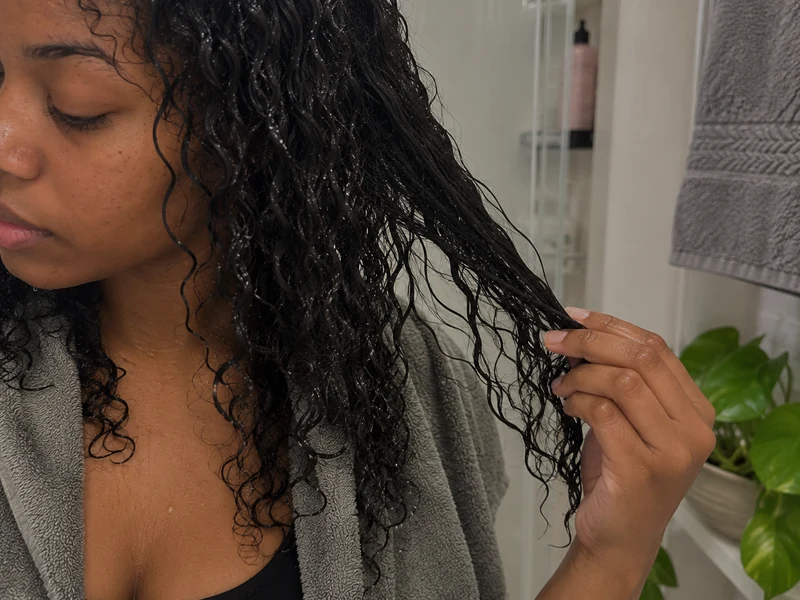
Water plasticises the fibre. Wet hair stretches further before it breaks, and the swollen cuticle is more vulnerable to abrasion. Those two effects pull in opposite directions, which is exactly why the advice is contested.
Why "never detangle wet hair" is too strong
For many people with curly and coily patterns, detangling with conditioner and slip in the shower involves far less force than fighting dry tangles. For others, gentle dry or damp detangling is easier on the fibre.
What matters is the force applied, the tool, the amount of lubrication and how tangled the hair already is — not a slogan.
What generally reduces breakage regardless of wet or dry?
Working in sections, starting at the ends and moving upward, using enough slip, choosing a tool that doesn't catch, and stopping to separate a knot with your fingers instead of pulling through it.
Does rough towel-drying matter?
Friction on a swollen cuticle is a plausible contributor to surface wear. Blotting or squeezing with a smooth towel is a low-cost change if you're troubleshooting breakage.
Judge by results, not rules
If you're finding short broken pieces, change one variable at a time — the tool, the lubrication, the timing — and watch what happens over a few wash days. Your own record is better evidence than a general rule.
How Hairavie knows this
Hairavie cites peer-reviewed research, scientific reviews, reference textbooks, dermatology organisations and government health resources. Beauty blogs are never used as scientific authority.
- Reference textbookRobbins, C. R. (2012). Chemical and Physical Behavior of Human Hair (5th ed.). Springer
- Peer-reviewed studyKoyama, T. et al. (2013). Understanding the role of mechanical damage in hair fibre breakage. Journal of Cosmetic Science
- Scientific reviewGavazzoni Dias, M. F. R. (2015). Hair cosmetics: an overview. International Journal of Trichology
Keep reading
Hair Growth 101
How hair is made, the phases every follicle moves through, and why shedding and breakage are not the same thing.
6 min readUnderstanding Your Hair Pattern
Pattern describes the shape your hair takes. It is a useful description, not a complete profile of how your hair behaves.
5 min readFine, Medium & Coarse Strands
Strand thickness is the width of a single fibre. It is not the same as how much hair you have.
5 min readHairavie provides cosmetic hair-care education only. It does not diagnose or treat medical or scalp conditions. If symptoms persist or you're concerned about hair loss or scalp health, consult a qualified healthcare professional.